When big groups hold the reins, from the artist to the TV. The Syndicat des Musiques Actuelles (SMA) has just published a striking map of the ten biggest private operators that now shape a large part of the French music industry. Behind this seemingly neutral, almost clinical diagram lies a far…
The Syndicat des Musiques Actuelles (SMA) has just published a striking map of the ten biggest private operators that now shape a large part of the French music industry. Behind this seemingly neutral, almost clinical diagram lies a far more vivid reality: that of an industry where independence is becoming rare, sometimes even symbolic.
Festivals, venues, media, ticketing, production… today, a handful of groups hold every lever. This isn’t new, but the phenomenon has intensified, and the SMA map offers a crystal-clear visual reading of it. It shows how certain players manage to orchestrate an artist’s career from start to finish. A label signs a promising name. The same group’s TV channel gives them a slot on set. Their music is played on a partner radio station. They then turn up on the bill of a festival or a Zénith run by that same structure, with tickets sold through its own platform.
On screen, it all looks natural. Yet everything is integrated.
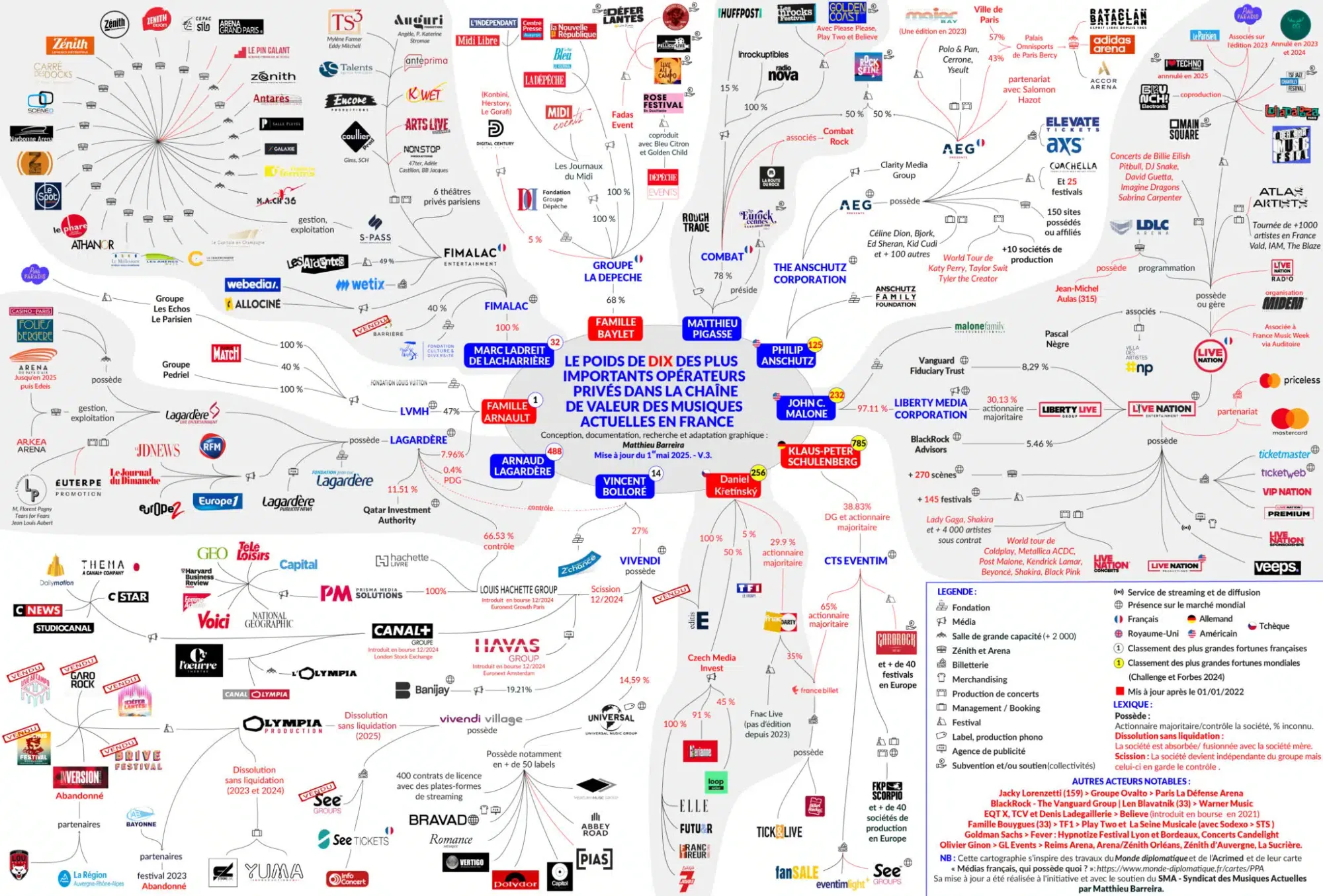
© SMA map
There is nothing illegal about this organisation. It is even formidably effective. But it blurs the line between organic success and engineered success. Between artistic discovery and commercial strategy. And in this logic, independent artists are often the first to pay the price: less visibility, narrower routes in, and a race for recognition that demands more effort and more time.
Behind the map are familiar names: Bolloré, Pigasse, Malone, Arnault. But also figures less known to the general public, such as Daniel Kretinsky, who now owns France Billet, part of TF1 and the Editis group. Klaus-Peter Schulenberg, through CTS Eventim, controls some forty festivals in Europe, including Garorock. GL Events now runs the Stade de France. Even Fever, a start-up born in Madrid, is setting up in France with its immersive concerts and its own festivals.
Each has its own logic, its own style, its own turf. But all are part of the same transformation: that of a landscape where music becomes a global, rationalised, interconnected product. You find the same headliners, the same formats, sometimes even the same stories, from Brazil to Paris.
The SMA map doesn’t take sides. It doesn’t denounce, it shows. And what it reveals is French music that is increasingly concentrated in its means of distribution. It isn’t an end in itself. But it is a change worth facing squarely.
Independence hasn’t disappeared. It is simply becoming a more demanding choice. And perhaps that is where the essential role of specialist media, programmers and curators lies: preserving that fragile space where new talent can still emerge. Because ultimately, musical richness also lies in what escapes the algorithms.